

NTA Salary Scale Afghanistan: Complete Guide to Categories, Steps & Monthly Pay (AFN & USD)
Complete guide to Afghanistan's NTA salary scale: categories A–H, all AFN steps, progression rules, recruitment, CBR relationship, oversight — plus FAQs for Google & AI search.
If you work in Afghanistan's development sector, apply for government-funded projects, or manage HR for a donor-supported program, the NTA salary scale is something you must understand inside and out. Whether you are a job seeker trying to negotiate your pay or a project manager building a budget, this guide gives you everything — category breakdowns, monthly salary figures in both AFN and USD, step progression rules, recruitment conditions, and more.
This is a detailed, practical guide on the National Technical Assistance (NTA) salary scale — with visuals and tables you can share with your team. Branding on graphics: khaliddanishyar.com.
What Is the NTA Salary Scale?
The National Technical Assistance (NTA) salary scale is a standardized pay framework developed by the Government of Islamic Republic of Afghanistan (GoIRA) through the Ministry of Finance. It was created following Presidential Decree No. 852 and approved by the Cabinet of Ministers to bring consistency and fairness to how national staff are paid across all donor-funded and government projects.
Before the NTA guideline existed, different ministries set salaries through individual agreements with donors. This created serious problems — high staff turnover, institutional knowledge loss, pay inequality, and low accountability. The NTA salary scale was built specifically to solve these problems.
The scale applies to all national staff working outside the official Tashkeel (permanent civil service positions), including Externally Funded Staff (EFS) supported by international donors. It does not apply to staff hired directly by donors for their own offices, or to short-term consultants engaged for fewer than three months.
Why the NTA Salary Scale Matters
- For Job Seekers: It tells you exactly what salary range to expect based on your education and years of experience. You walk into negotiations informed.
- For HR Managers: It provides a legally grounded, government-approved structure for placing staff in the correct grade and step without guesswork or favoritism.
- For Donors and Project Managers: It supports accurate budget planning using fixed AFN amounts per grade and step, with USD equivalents calculated based on 260 working days per year.
- For Government Accountability: It reduces corruption in recruitment, prevents excessive salaries for politically connected individuals, and creates a transparent record for audit.
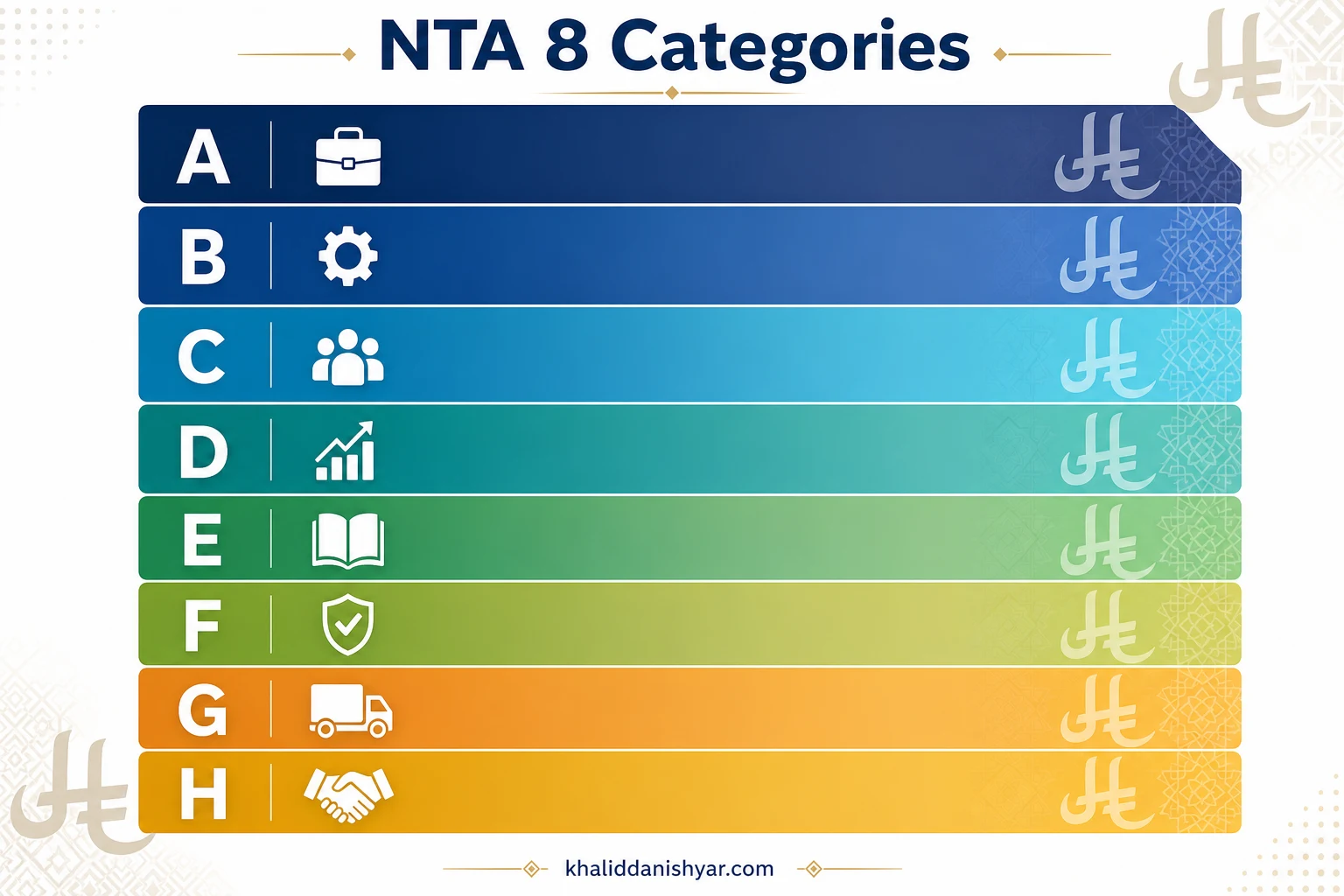
The 8 NTA Job Categories Explained (Grade A to H)
The NTA scale divides all national technical assistance positions into eight grades (A through H). Each grade has ten steps. The grade reflects the complexity of the role, required education, and years of experience.
Category A — Senior Executive Level
Purpose: Strategic management, vision-setting, and organizational leadership at the highest level.
Example roles: Country Director, Chief of Party, Senior Advisor to Ministers, Director General-equivalent positions in civil service.
Key responsibilities: Full management authority over HR, finance, and administration. Setting long-term organizational strategies. Representing the organization at national and international levels.
Minimum requirements: Doctorate degree with 3 years of relevant experience, OR Master's degree with 5 years, OR Bachelor's degree with 10 years of relevant experience.
Salary range: AFN 160,000 (Step 1) to AFN 320,000 (Step 10) per month.
Category B — Directors and Senior Specialists
Purpose: Managing the administrative and technical affairs of an organization or project at the senior level.
Example roles: Head of Division, Senior Technical Specialist, Deputy Project Manager, Project Coordinator at the national level, Senior Advisor to Deputy Ministers.
Key responsibilities: Developing organizational strategies, managing resources, planning and finding solutions for problems and challenges across the division or project.
Minimum requirements: Master's degree or equivalent with 5 years of relevant experience, OR Bachelor's degree with 7 years of relevant working experience.
Salary range: AFN 128,000 (Step 1) to AFN 256,000 (Step 10) per month.
Category C — Mid-Level Advisors and Coordinators
Purpose: Development, implementation, and management of specific functions within an organization or project.
Example roles: Technical Advisor, Program Officer, Senior Officer, Manager, Technical Specialist, Grade 3-equivalent civil servants.
Key responsibilities: Managing organizational resources within defined boundaries, providing professional and technical advice to senior managers, supervising project teams, and managing budgets for specific functions.
Minimum requirements: Bachelor's degree with 5 years of relevant experience in the related field.
Salary range: AFN 76,000 (Step 1) to AFN 140,000 (Step 10) per month.
Category D — Officers and Unit Managers
Purpose: Providing technical and managerial support, implementing plans, and supervising related functional units.
Example roles: Officer, Unit Manager, Grade 4-equivalent civil servant positions.
Key responsibilities: Preparing financial, operational, technical, and other plans for the organization or project. Implementing related parts of the organization's or project's work. Supervising and managing related functional units.
Minimum requirements: Bachelor's degree with 4 years of relevant experience in the related field.
Salary range: AFN 38,000 (Step 1) to AFN 89,000 (Step 10) per month.
Category E — Associates and Field Officers
Purpose: Performing operational, support, educational, technical, and other tasks of the organization or project.
Example roles: Field Engineer, Community Mobilizer, Surveyor, Associate Officer.
Key responsibilities: Responsible for resources within defined boundaries. Implementing departmental plans to agreed standards. Coordinating activities with related departments. Communicating with interested persons both internally and externally.
Minimum requirements: Bachelor's degree with 3 years of relevant experience, OR 5 years of relevant working experience without a degree.
Salary range: AFN 25,000 (Step 1) to AFN 51,000 (Step 10) per month.
Category F — Assistants and Administrative Clerks
Purpose: Performing administrative support tasks within the department.
Example roles: Assistant, Clerk, Administrative Associate.
Key responsibilities: Delivery of managerial and technical tasks as per working plans. Supporting and implementing the organization or project's operational plans. Coordinating activities with other related units. Reporting to project management.
Minimum requirements: Bachelor's degree with 2 years of relevant experience, OR Baccalaureate degree with 4 years of relevant experience.
Salary range: AFN 22,000 (Step 1) to AFN 40,000 (Step 10) per month.
Category G — Technicians and Support Staff
Purpose: Performing administrative support tasks of the department.
Example roles: Technician, Driver, Data Entry Operator.
Key responsibilities: Carrying out daily tasks assigned to them. Preparing, typing, and managing the filing of the organization's documents. Coding when needed.
Minimum requirements: Baccalaureate degree from school or an educational/professional institute, as per the job requirement.
Salary range: AFN 18,000 (Step 1) to AFN 35,000 (Step 10) per month.
Category H — Manual and Basic Labour Positions
Purpose: Manual labour as required by the position.
Example roles: Cleaner, Housekeeper, Chief (cook).
Key responsibilities: Undertaking day-to-day routine work assigned by a supervisor.
Minimum requirements: Basic knowledge of equipment under care.
Salary range: AFN 8,000 (Step 1) to AFN 17,999 (Step 10) per month.
Full NTA Salary Scale Table (AFN — All Grades & Steps)
All figures below are in Afghan Afghani (AFN). For quick USD orientation only, divide AFN by an illustrative 70 AFN per 1 USD (example rate for mental math — always use your official project / Treasury rate for budgets and contracts).
| Grade | Step 1 | Step 2 | Step 3 | Step 4 | Step 5 | Step 6 | Step 7 | Step 8 | Step 9 | Step 10 |
|---|---|---|---|---|---|---|---|---|---|---|
| A | 160,000 | 177,778 | 195,556 | 213,333 | 231,111 | 248,889 | 266,667 | 284,444 | 302,222 | 320,000 |
| B | 128,000 | 142,222 | 156,444 | 170,667 | 184,889 | 199,111 | 213,333 | 227,556 | 241,778 | 256,000 |
| C | 76,000 | 83,111 | 90,222 | 97,333 | 104,444 | 111,556 | 118,667 | 125,778 | 132,889 | 140,000 |
| D | 38,000 | 43,667 | 49,333 | 55,000 | 60,667 | 66,333 | 72,000 | 77,667 | 83,333 | 89,000 |
| E | 25,000 | 27,889 | 30,778 | 33,667 | 36,556 | 39,444 | 42,333 | 45,222 | 48,111 | 51,000 |
| F | 22,000 | 24,000 | 26,000 | 28,000 | 30,000 | 32,000 | 34,000 | 36,000 | 38,000 | 40,000 |
| G | 18,000 | 19,889 | 21,778 | 23,667 | 25,556 | 27,445 | 29,334 | 31,223 | 33,112 | 35,000 |
| H | 8,000 | 9,111 | 10,222 | 11,333 | 12,444 | 13,555 | 14,666 | 15,777 | 16,888 | 17,999 |
All figures are in Afghan Afghani (AFN). The interval within each step is fixed using a multiplier system applied to the original P&G civil servant salary.
Salary Step Progression Rules: How You Move Up
- New recruits start at Step 1 of their assigned grade by default.
- One additional step can be offered if the candidate holds a Master's or PhD degree.
- One additional step can be offered if the candidate has two or more years of experience beyond what the Terms of Reference (TOR) requires.
- Technical positions may receive one further additional step, but no new hire can be placed above Step 5 under any circumstances. Step 5 offers are considered exceptional and require strong justification.
- Annual step increases are only possible after a successful performance appraisal. Without a formal performance review, no salary increase is permitted.
- The CBR standard format for performance appraisal is strongly recommended, though each project's internal procedure may apply.
One important special rule: Senior Officers are placed in Grade 3 of Category D, and a Senior Officer can only be promoted up to Step 5 of that grade. They cannot be offered a position above Step 1 of Grade 3 at the time of hiring.
What the NTA Salary Includes — and What It Does Not
Many applicants assume the salary figure covers all their work-related costs. This is a common mistake.
- The NTA salary includes: Basic monthly pay plus all regular benefits and allowances that are part of the standard compensation package.
- The NTA salary does NOT include: Transportation allowances, communication (phone/internet) costs, and insurance coverage. These must be provided separately based on each organization's internal policy and agreements.
This is a critical distinction when you are comparing offers across different organizations, as the total compensation package can vary significantly based on what extras an employer adds on top of the base NTA scale.
Recruitment Rules: How NTA Hiring Must Work
The NTA guideline is strict about how staff are hired. All NTA recruitment must follow an open competitive process. Direct hiring — without a competitive process — is not allowed, except for very specific technical positions. Management positions are explicitly stated as not qualifying for direct recruitment.
Every NTA position must have a Terms of Reference (TOR) that follows the standard NTA format, which is annexed to the guideline. This standardized TOR ensures that job descriptions are consistent, transparent, and aligned with the salary grade being offered.
NTA vs CBR: Understanding the Relationship
The NTA scale is built on top of the Capacity Building for Results (CBR) salary scale, which covers Grades 1 to 5 of the Tashkeel civil service. The new NTA scale from Grade 1 to 5 matches the CBR scale exactly. NTA then extends downward with three additional grades (proportionally calculated) to cover all levels of national staff — including drivers, cleaners, and field technicians — that CBR does not address.
This means NTA is a comprehensive extension of CBR, designed to unify pay across all levels without creating competition or pay gaps between Tashkeel civil servants and externally funded national staff.
Supervision and Compliance: Who Enforces the NTA Scale?
A Supervisory Committee (SC) was established within the Budget Department of the Ministry of Finance to oversee implementation. The committee includes representatives from IARCSC, the World Bank (representing ARTF responsibilities), and one rotating member from other key donors.
- Collecting quarterly data on NTA contract numbers, salaries, durations, and types from all stakeholders
- Maintaining a database of all on-budget and off-budget NTA contracts
- Reporting to the CBR Steering Committee per Presidential Order No. 852
- Revising the NTA salary scale in consultation with donors and GoIRA offices when necessary
Final Thoughts
The Afghanistan NTA salary scale is one of the most important compensation frameworks in the country's public and development sectors. It creates a level playing field for job seekers, gives HR professionals a defensible structure, gives donors confidence in budget projections, and gives the government visibility and control over how national staff are paid.
Whether you are entering the job market for the first time, managing a multi-million dollar development project, or reviewing contracts as part of a compliance audit, understanding every layer of the NTA scale — the grades, the steps, the progression rules, the exclusions, and the oversight structure — gives you a clear, confident foundation to work from.
The guideline is not just a pay table. It is a governance tool. And when it is followed properly, it builds exactly the kind of institutional trust that Afghanistan's development sector needs. — khaliddanishyar.com
Frequently asked questions
NTA salary scale FAQ
Short answers on grades, steps, AFN pay bands, recruitment rules, and oversight — written for job seekers, HR teams, and project managers. FAQ structured data is emitted for search and AI assistants.