

Afghan Date Converter: The Complete Guide to Shamsi, Gregorian & Hijri Calendar Conversion
Learn how to use the Afghan Date Converter for Shamsi (Solar Hijri), Gregorian (Miladi), and Hijri Qamari dates. Includes live Afghanistan time, calendar history, and step-by-step usage.
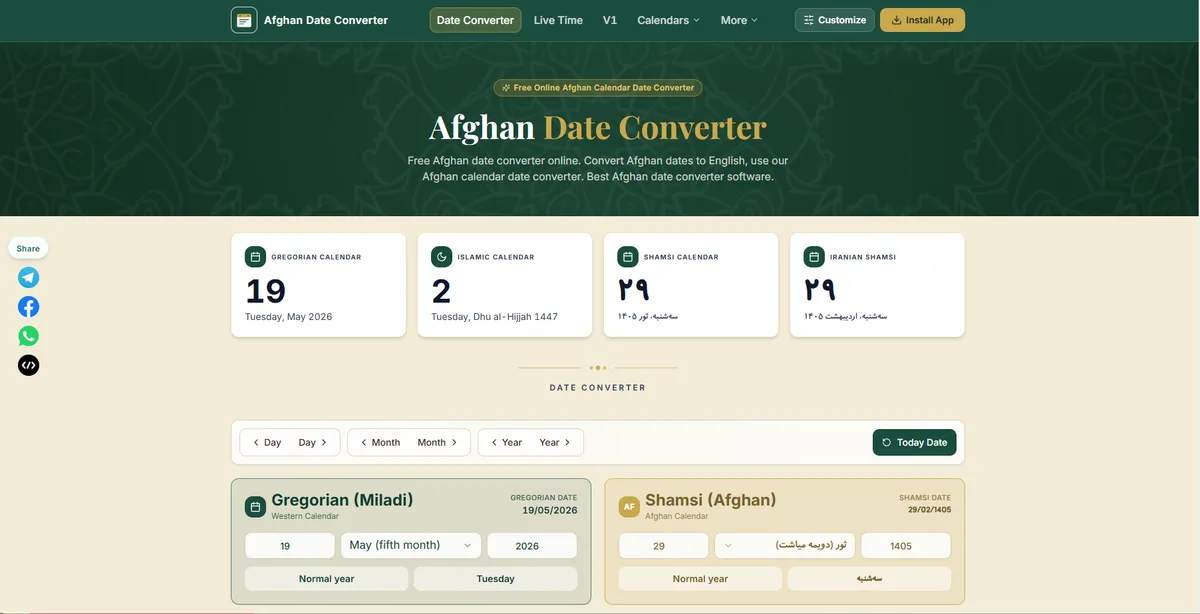
If you live in Afghanistan, work with Afghan institutions, or communicate with Afghans around the world, you already know the confusion that comes from dealing with three different calendar systems at once. A government document uses the Shamsi date. International colleagues reference the Gregorian date. Your local mosque announces events according to the Hijri Qamari calendar. Keeping track of all three without making errors is genuinely difficult.
That is exactly why the Afghan Date Converter was built. It takes the friction out of date conversion completely. Whether you need to convert a Shamsi birth date to Miladi for a visa application, check today's Afghan date in real time, or plan around an Islamic holiday, this tool handles it in seconds: free, with no registration required.
This guide walks you through everything you need to know: the history behind Afghanistan's calendars, how the converter works, and how to get the most out of each feature on the site.
3
Calendar systems
Free
No signup
AFT
UTC+4:30 live time
Fast
Browser-based
Understanding Afghanistan's Three Calendar Systems
Before you can appreciate how powerful the Afghan Date Converter is, it helps to understand why three different calendars exist side by side in Afghan daily life. Each one carries a distinct purpose, history, and community of users.
The Shamsi Calendar (Hijri Shamsi / Solar Hijri)
The Shamsi calendar, also called the Solar Hijri or Afghan Solar calendar, is the official civil calendar of Afghanistan. Every government office, public school, national holiday, and legal document in the country uses this calendar. When an Afghan says "today is 29 Sawr 1404," they are using the Shamsi system.
This calendar is solar: it tracks the Earth's journey around the Sun. Its year begins on Nawroz (New Year), which falls on or around March 21 of the Gregorian calendar, the spring equinox. The roots stretch back to ancient Persia. The 11th-century mathematician and poet Omar Khayyam played a significant role in refining its astronomical precision. Afghanistan officially adopted it in 1925 under King Amanullah Khan.
The Shamsi calendar has 12 months. The first six (Hamal through Sunbula) each have 31 days. The next five (Mizan through Dalwa) each have 30 days. Hoot has 29 days in a regular year and 30 in a leap year, keeping the calendar aligned with the solar year.
The Gregorian Calendar (Miladi)
The Gregorian calendar is the international standard most of the world uses today. Afghanistan uses it for external communication, international travel documents, business contracts with foreign partners, and digital platforms. When an Afghan applies for a passport, university abroad, or a foreign visa, the Gregorian calendar is the reference point.
Pope Gregory XIII introduced this calendar in 1582 as a reform of the Julian calendar. Today, 168 countries use it as their primary civil calendar. The current Gregorian year 2026 corresponds approximately to Shamsi year 1404.
The gap between the two systems is roughly 621 to 622 years, depending on the time of year. This offset exists because the Shamsi calendar counts from the Hijra (the Prophet Muhammad's migration from Mecca to Medina in 622 CE), but uses a solar rather than a lunar counting method.
The Hijri Qamari Calendar (Islamic Lunar Calendar)
The Hijri Qamari calendar is the lunar calendar used across the Muslim world for religious observances. In Afghanistan, it determines the dates of Ramadan, Eid al-Fitr, Eid al-Adha, Mawlid al-Nabi, Ashura, and other Islamic occasions. Unlike the Shamsi calendar, which is solar and stays anchored to the seasons, the Hijri Qamari calendar is purely lunar. Each month begins with the sighting of the new crescent moon.
Because a lunar year is approximately 11 days shorter than a solar year, Hijri dates shift backward through the Gregorian and Shamsi calendars every year. That is why Ramadan falls at a different season each year, rotating through summer, spring, winter, and autumn over a 33-year cycle.
What Is AfghanDateConverter.com?
AfghanDateConverter.com is a free, browser-based tool that converts dates between the Shamsi, Gregorian (Miladi), and Hijri Qamari calendar systems. It requires no download, no login, and no payment. You open the site, enter a date in any one of the three calendars, and it instantly shows you the equivalent date in the other two.
The site also includes two additional pages that make it uniquely useful:
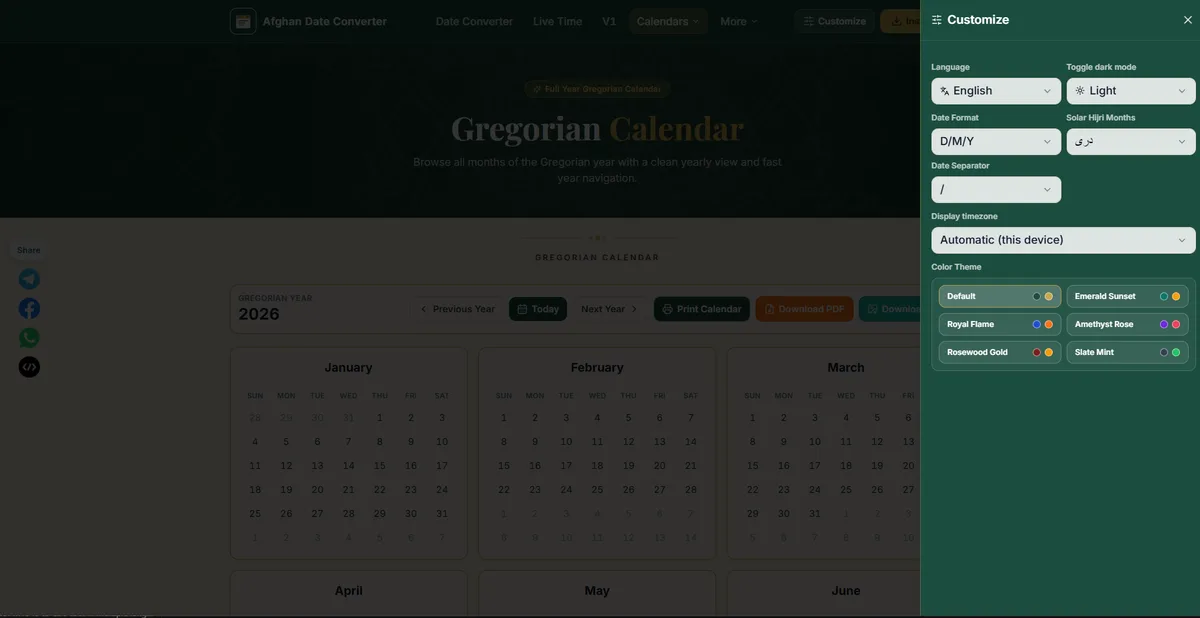
- Gregorian Calendar: a full visual calendar in the Gregorian system, helping users cross-reference monthly dates with their Shamsi or Hijri equivalents.
- Live Time: a real-time clock showing the current date and time in Afghanistan Time (AFT), which runs at UTC+4:30.
How to Use the Afghan Date Converter: Step by Step
Using the converter is straightforward. Here is a clear walkthrough for each common task.
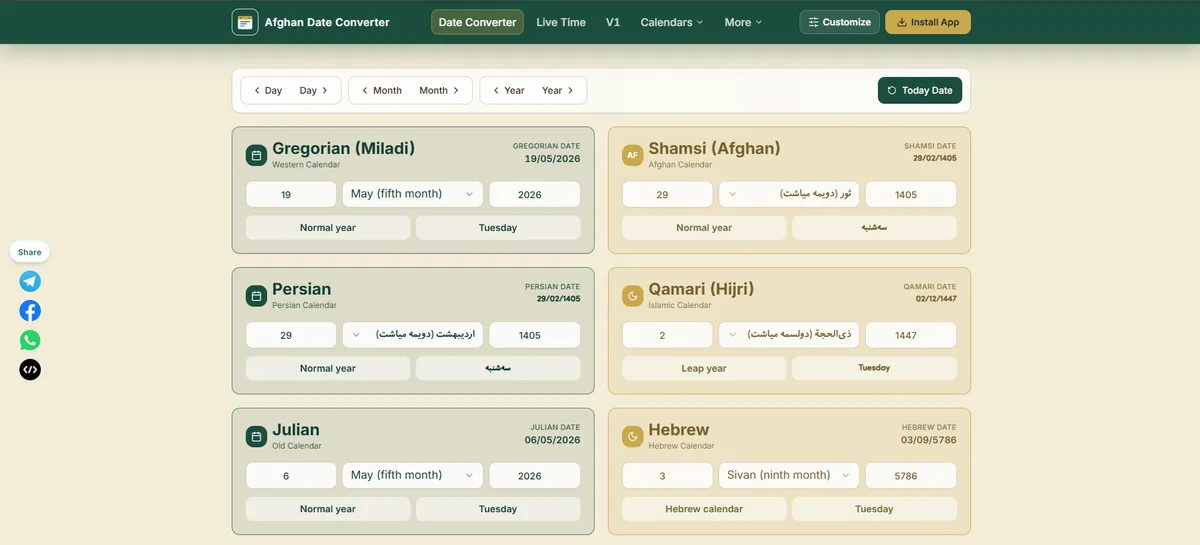
Converting a Shamsi Date to Gregorian (Miladi)
This is the most common use case. Afghans applying for foreign visas, university admissions abroad, or international employment often need to convert their Shamsi birth date, marriage date, or document date into the Gregorian format.
- Open afghandateconverter.com.
- Select the Shamsi calendar as your input.
- Enter the year, month, and day in Shamsi format, for example 15 Mizan 1402.
- The tool instantly displays the Gregorian equivalent, in this case October 7, 2023.
- Copy the converted date directly to use in your documents.
Converting a Gregorian Date to Shamsi
Afghans living abroad who receive international documents (bank statements, medical records, school transcripts) often need the Shamsi equivalent of a Gregorian date for official Afghan paperwork.
- Select the Gregorian calendar as your input.
- Enter the day, month, and year, for example March 21, 2026.
- The converter immediately shows the Shamsi date: 1 Hamal 1404, which is Nawroz, Afghan New Year.
Finding Today's Afghan Date
If you simply want to know what today's date is in the Shamsi calendar, the Live Time page is your fastest option. It shows the current Shamsi date alongside the live clock in Afghanistan Time (AFT, UTC+4:30). For Afghans in the diaspora who live in a different timezone, this feature keeps them connected to the rhythm of life back home.
The Gregorian Calendar Page: A Practical Cross-Reference Tool
The Gregorian Calendar page on AfghanDateConverter.com is more than just a standard monthly view. It gives users a structured visual reference they can use to plan events, track deadlines, and match international dates with Afghan calendar dates.
This is particularly useful for:
- Afghan businesses working with international clients who need to schedule meetings or deadlines across calendar systems.
- Afghan students abroad who receive assignment deadlines in Gregorian format but think and plan in Shamsi dates.
- Afghan parents in the diaspora who want to mark Afghan national holidays and Nawroz on a Gregorian calendar for their children.
- NGO workers and researchers operating in Afghanistan who need to cross-reference Afghan document dates with international reporting periods.
The Live Time Feature: Afghanistan's Clock for the World
Afghanistan operates on Afghanistan Time, officially designated AFT, which sits at UTC+4:30. This is an unusual half-hour offset. Most countries use full-hour time zones, but Afghanistan has maintained this thirty-minute offset for decades.
For Afghans living in Europe, North America, Australia, or the Gulf states, keeping track of Kabul time is a daily necessity. When is the right moment to call family? When do Afghan government offices open? When does the Friday prayer time fall in Kabul today?
The Live Time page answers all of these questions instantly. It displays:
- The current Afghanistan Time (AFT) clock, updating live.
- The current Shamsi date.
- The current Gregorian date.
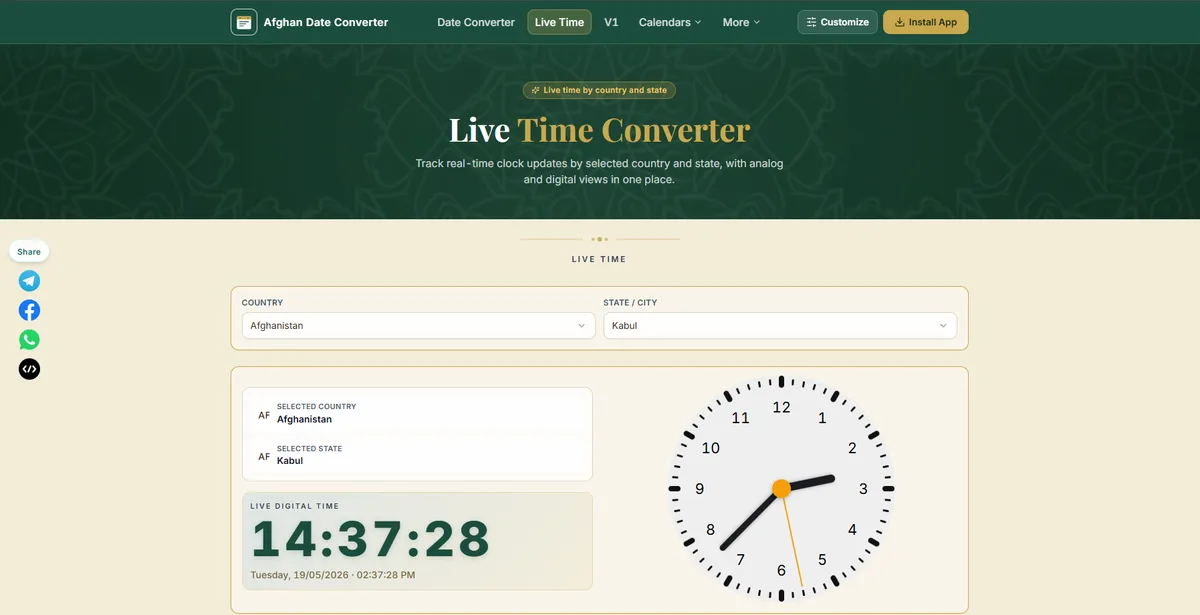
This feature runs entirely in your browser. No server sends you data after the page loads. The clock updates using your device's own system, calibrated to Afghanistan's UTC+4:30 offset. This makes it fast, private, and reliable even on a slow connection.
Who Benefits Most from the Afghan Date Converter?
The Afghan Date Converter serves a wide range of users. Here are the groups that rely on it most:
Official paperwork
Birth certificates, property deeds, marriage certificates, and court documents use Shamsi dates. Accurate conversion to Gregorian is essential for embassies and international organizations.
The Afghan diaspora
Millions of Afghans abroad stay connected to home while navigating Gregorian daily life. The converter helps plan Nawroz, family calls, and cross-border matters.
Journalists and researchers
Primary sources often use Shamsi dates. Accurate conversion supports factual reporting and academic integrity.
NGOs and international orgs
Development agencies and embassies routinely deal with Shamsi-dated documents. Accurate conversion supports proper record-keeping.
Muslims worldwide also use the Hijri Qamari conversion feature to find exact Gregorian or Shamsi dates for Ramadan, Eid, and other Islamic occasions in a given year.
Why Use AfghanDateConverter.com Instead of General Converters?
Several general-purpose date converters exist online, but most are built for a global audience and do not prioritize the Afghan Shamsi calendar specifically. AfghanDateConverter.com is built with the Afghan user in mind. The interface is clean and intuitive. The conversions are accurate. The Live Time feature is calibrated specifically to Afghanistan Time. And the Gregorian Calendar page provides a visual monthly reference that general converters do not offer.
The tool also works entirely in your browser. No personal data leaves your device during conversion. No account is required. For users who value privacy and simplicity, this matters.
Conclusion: One Tool, Three Calendars, Zero Confusion
Navigating three calendar systems (Shamsi, Gregorian, and Hijri Qamari) is a part of everyday life for millions of Afghans. The Afghan Date Converter removes the guesswork, manual calculations, and risk of errors from that process entirely.
Whether you convert a birth date for a visa application, check today's Shamsi date from across the world, or plan an Islamic observance using the Hijri calendar, AfghanDateConverter.com gives you accurate results in seconds. Bookmark it, share it with family and colleagues, and use it every time Afghanistan's three calendars cross paths in your life.
Convert Shamsi, Gregorian, and Hijri Qamari dates instantly.
Open Afghan Date Converter →Frequently asked questions
Frequently Asked Questions About Afghan Date Conversion
Quick answers on Shamsi vs Gregorian years, Afghan vs Iranian calendars, Hijri moon sighting, and Afghanistan Time (AFT).